

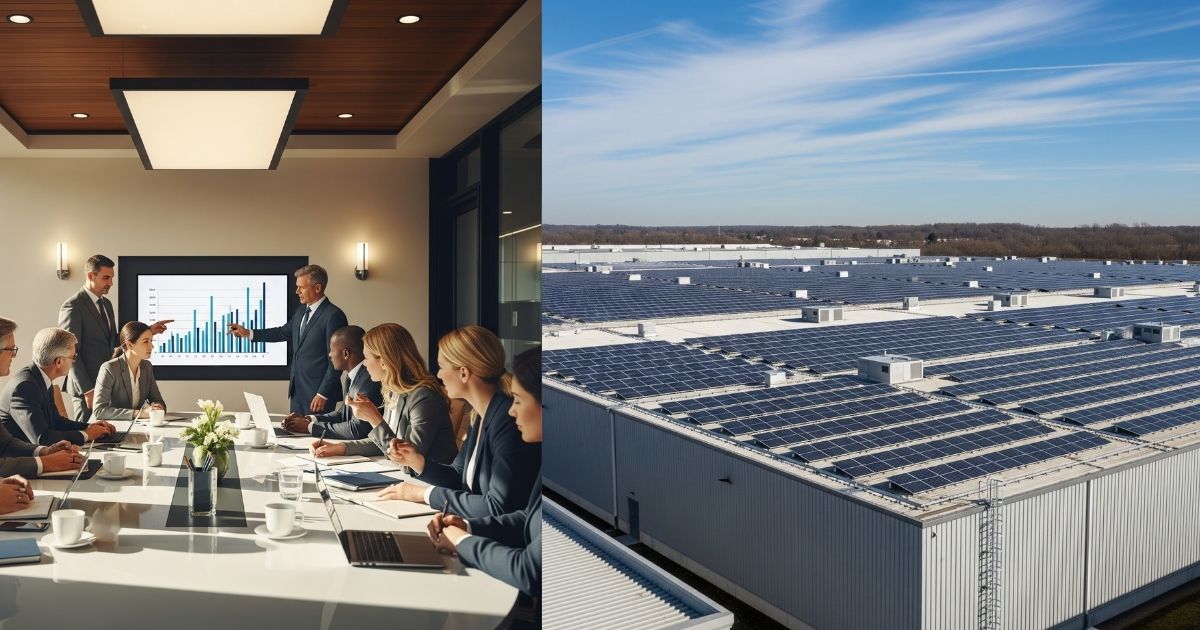
Grid electricity prices aren’t stabilising any time soon. With average commercial rates pushing toward 22–25p/kWh and energy costs forming an increasingly large line on the P&L, more UK businesses are running the numbers on solar — not as a sustainability gesture, but as a hard financial decision.
This guide works through the real return on investment figures for commercial solar in 2026, using actual installation costs, current energy rates, and live incentives. No estimates dressed up as guarantees — just the maths, clearly shown.
What ROI Can a Business Expect from Commercial Solar?
Most UK businesses achieve an ROI of 10–17% on a commercial solar investment, with payback periods typically falling between 4 and 10 years. The range is wide because the variables are real — system size, location, how much generated electricity is consumed on-site, and whether battery storage or other technologies are integrated all shift the numbers meaningfully.
What’s changed in recent years is that falling installation costs — down 10–20% over the last few years — combined with rising grid prices have made the financial case considerably stronger than it was five years ago.
How Is Commercial Solar ROI Calculated?
The formula is straightforward:
ROI = (Annual Net Savings ÷ Initial Investment) × 100
Payback Period = Initial Investment ÷ Annual Net Savings
Annual net savings combines the electricity you no longer buy from the grid, income from exporting surplus power via the Smart Export Guarantee (SEG), minus annual maintenance costs.
Current incentives worth factoring in:
0% VAT on solar installations (in place until March 2027)
Annual Investment Allowance (AIA) — 100% tax relief on solar up to £1 million in the year of purchase
Smart Export Guarantee (SEG) — payments of up to 15p/kWh for surplus electricity exported to the grid
For businesses eligible for AIA at a 25% tax rate, the effective net cost of the installation drops by 25%, which meaningfully improves the adjusted ROI figure.
Base Scenario: 50kW Roof-Mounted System in Central UK
A 50kW roof-mounted system is a realistic starting point for a medium-sized business consuming around 100,000 kWh per year.
| Metric | Detail | Value |
|---|---|---|
| Initial Investment | £1,312/kW × 50kW | £65,600 |
| Annual Generation | 50kW × 900 kWh/kWp | 45,000 kWh |
| Self-Consumed Savings | 45,000 × 70% × 22p/kWh | £6,930 |
| Exported Earnings (SEG) | 45,000 × 30% × 15p/kWh | £2,025 |
| Maintenance Cost | £65,600 × 1% | £656 |
| Annual Net Savings | £6,930 + £2,025 – £656 | £8,299 |
| Payback Period | £65,600 ÷ £8,299 | 7.9 years |
| ROI | (£8,299 ÷ £65,600) × 100 | 12.65% |
| Post-AIA Net Cost (25% tax) | £65,600 × 75% | £49,200 |
| Adjusted ROI | (£8,299 ÷ £49,200) × 100 | 16.87% |
Over 25 years, cumulative savings from this system could exceed £207,000 at flat energy prices — rising to £300,000+ when energy inflation of 5–7% annually is factored in.
How Does Location Affect Commercial Solar ROI?
Solar output varies by 20–30% depending on where in the UK your building sits. Southern regions receive meaningfully higher annual irradiance than northern ones, which shows up directly in the payback period.
| Metric | Southern UK | Northern UK |
|---|---|---|
| Annual Generation | 50,000 kWh | 40,000 kWh |
| Annual Net Savings | £9,294 | £7,304 |
| Payback Period | 7.1 years | 9.0 years |
| ROI | 14.17% | 11.13% |
Northern UK businesses still achieve solid returns — the payback period is longer but the system lifespan is the same. It’s worth factoring your specific location into any site assessment rather than using national averages.
Roof-Mounted vs Ground-Mounted: Which Delivers Better ROI?
Ground-mounted systems allow for optimal panel angle and orientation, which improves generation — but the higher installation cost offsets much of that gain.
| Metric | Roof-Mounted | Ground-Mounted |
|---|---|---|
| Initial Investment | £65,600 | £77,080 |
| Annual Generation | 45,000 kWh | 50,625 kWh |
| Annual Net Savings | £8,299 | £9,303 |
| Payback Period | 7.9 years | 8.3 years |
| ROI | 12.65% | 12.07% |
Ground-mounted systems make the most sense for land-rich businesses — farms, rural industrial sites, and depots — where the roof either isn’t suitable or where scale requires more space than the building footprint provides.
Does Adding Battery Storage Improve ROI?
Battery storage boosts on-site self-consumption and provides resilience against grid disruptions, but it increases the initial investment significantly. Whether it improves ROI depends heavily on your energy tariff structure.
| Metric | Without Battery | With 100kWh Battery | With Peak Tariff Savings |
|---|---|---|---|
| Initial Investment | £65,600 | £125,600 | £125,600 |
| Annual Net Savings | £8,299 | £8,392 | £10,070 |
| Payback Period | 7.9 years | 15.0 years | 12.5 years |
| ROI | 12.65% | 6.68% | 8.02% |
The case for battery storage strengthens considerably if your business is on a time-of-use tariff with meaningful peak/off-peak rate differences. Battery prices have also continued to fall, which improves the numbers further for installations planned later in 2026.
What Happens When You Integrate a Heat Pump?
Solar panels pair well with heat pumps — particularly for businesses currently running gas heating. A heat pump with a coefficient of performance (COP) of 3.5 generates 3.5 units of heat for every unit of electricity it consumes, and powering it with on-site solar generation significantly reduces running costs.
| Metric | Without Heat Pump | With Heat Pump | With 5% Gas Inflation |
|---|---|---|---|
| Initial Investment | £65,600 | £95,600 | £95,600 |
| Annual Net Savings | £8,299 | £9,229 | £9,529 |
| Payback Period | 7.9 years | 10.4 years | 9.5 years |
| ROI | 12.65% | 9.65% | 10.31% |
The combined system costs more upfront and extends the payback period, but as gas prices continue to rise the annual saving gap narrows that difference over time.
What About Combining Solar with a Small Wind Turbine?
For businesses in coastal or exposed locations, a small wind turbine alongside solar creates a hybrid system that generates in conditions where solar alone would underperform — overnight, in winter, or during overcast periods.
| Metric | Solar Only | Solar + 10kW Wind |
|---|---|---|
| Initial Investment | £65,600 | £105,600 |
| Annual Net Savings | £8,299 | £11,879 |
| Payback Period | 7.9 years | 8.9 years |
| ROI | 12.65% | 11.25% |
The ROI is slightly lower due to the higher upfront cost, but the annual savings are meaningfully higher and the system is more resilient year-round. Worth modelling for any business where energy security is a priority alongside cost reduction.
Why Choosing the Right Installer Determines Your Actual ROI
The figures above assume a well-specified, correctly installed system. In practice, ROI can be significantly worse if the system is undersized for your consumption, panels are poorly oriented, the inverter is mismatched, or the DNO application is handled incorrectly.
A commercial solar installation is a long-term capital asset. The savings projections only hold if the system performs as designed for its full lifespan — and that comes down to the quality of the components specified and the experience of the team installing them.
As one of the best commercial solar panel installers in the UK, The Commercial Solar Company works exclusively in the commercial sector. Every system is designed around your specific energy profile, roof or ground conditions, and financial targets — not a standard package. We manage the full process in-house, from site survey and DNO application through to post-installation monitoring, so the numbers you’re quoted are the numbers the system is built to deliver.
Contact us today for a free site audit and personalised ROI calculation for your business.
Frequently Asked Questions
What Is the Typical Lifespan of a Commercial Solar System?
Panels typically last 25–30 years, with most manufacturers offering 25-year performance warranties. Inverters need replacing after 10–15 years — budget £5,000–£10,000 for a 50kW system. Annual maintenance running at around 1% of system cost covers cleaning, inspections, and performance checks.
How Does Asset Finance Work for Commercial Solar?
Asset finance spreads the installation cost over 5–10 years while your business retains ownership of the system and can still claim capital allowances. For many businesses, monthly repayments are offset by energy bill savings from day one, making the net cash impact close to neutral throughout the finance term.
Can Solar Be Installed on a Leased Commercial Property?
Yes, with landlord approval. Shorter lease terms tend to favour smaller systems or ground-mounted setups where the asset can potentially be relocated. We can advise on the right approach for your specific lease arrangement to ensure the investment still delivers a workable ROI.
How Do Winter Months Affect Annual Solar Output?
Winter output typically drops 50–70% compared to summer peak due to shorter days and lower sun angles. Annual ROI calculations account for this seasonal variation — a properly designed system is sized based on full-year generation, not just summer performance. Battery storage or hybrid wind integration helps smooth out seasonal gaps for businesses with consistent year-round demand.
Are There Any Grants Available Beyond AIA and SEG?
Some local councils offer funding for commercial energy efficiency projects, and certain sectors may have access to additional support through schemes like the UK Shared Prosperity Fund. Commercial solar grants availability varies by region and business type — we check eligibility as part of every site audit.
How Does Commercial Solar Work in Practice?
For a full breakdown of how commercial solar power systems work — from panel generation through to grid connection — see our dedicated guide.
All figures are estimates based on 2026 UK market data, a commercial electricity rate of 22p/kWh, and standard irradiance assumptions for central UK. Actual returns vary by location, energy usage, tariff structure, and system specification. Always obtain a site-specific assessment from an MCS-accredited installer before making investment decisions.
