

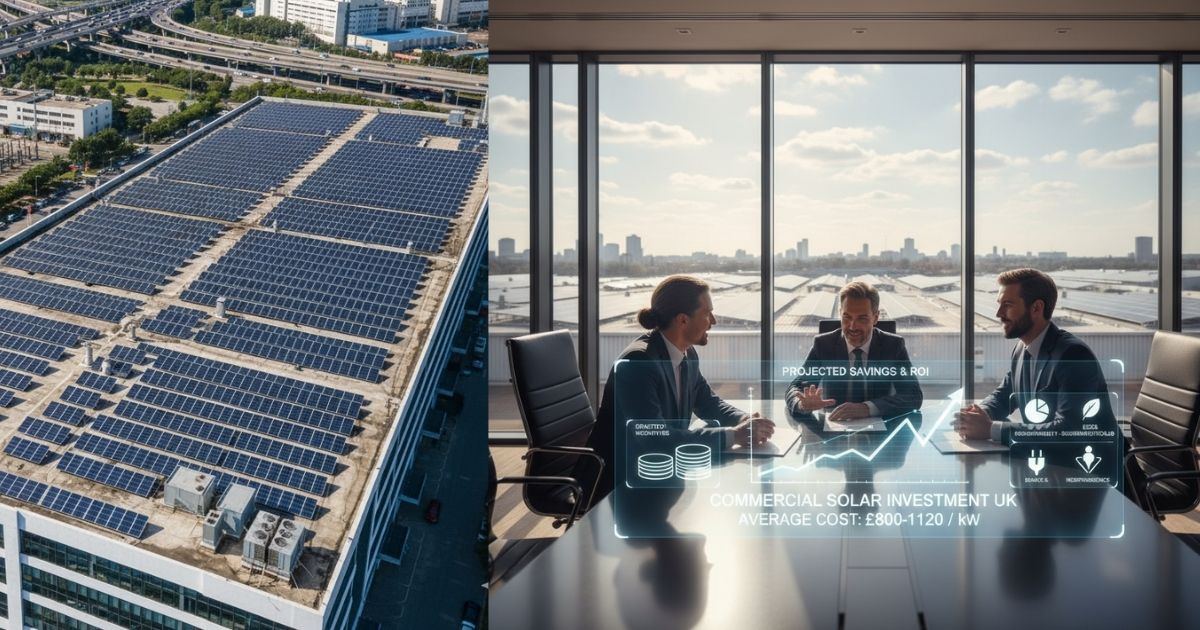
Commercial solar panels cost between £13,000 for a 10kW system and £120,000+ for a 100kW system in the UK, excluding VAT. For most businesses, the total investment pays back within 2–6 years — after which electricity is essentially free for the remaining life of the system.
This guide breaks down exactly what you’ll pay, what drives the price, and what you’ll get back.
What’s the Average Cost of Commercial Solar Panels in the UK?
The table below covers 2026 pricing for roof-mounted monocrystalline systems, including panels, inverters, mounting hardware, wiring, and labour.
| System Size | Cost Range (£) | Suitable For | Typical Payback |
|---|---|---|---|
| 10 kW | £13,000–£15,000 | Small offices, retail, cafes | 5–6 years |
| 20 kW | £16,000–£30,000 | Small warehouses, schools | 4–5 years |
| 50 kW | £33,000–£60,000 | Medium factories, leisure centres | 3–6 years |
| 60 kW | £39,000–£75,000 | Large offices, hospitals | 3–5 years |
| 80 kW | £50,000–£100,000 | Industrial units, universities | 3–6 years |
| 100 kW | £60,000–£120,000 | Large factories, distribution centres | 2–5 years |
All figures exclude VAT and are based on 2026 UK market data. Prices vary by site — always request quotes from MCS-accredited installers.
What Affects the Price of a Commercial Solar System?
When installing solar panels on a commercial building, these are the variables that push costs up or down.
System Size — The Biggest Price Factor
The larger the system, the higher the total cost — but the lower the cost per kW. A 10kW system for a small office costs £1,300–£1,500 per kW installed. A 100kW system for a factory can drop to £600–£1,200 per kW. Going bigger almost always improves your cost per unit of energy generated.
Panel Type — Monocrystalline vs Polycrystalline
Monocrystalline panels (15–22% efficiency) cost more upfront but generate more electricity per m² — worth the premium when roof space is limited
Polycrystalline panels cost roughly 20% less and make sense for large roofs where fitting more panels is straightforward
Roof Type — Flat Roofs Cost Less to Install On
Flat commercial roofs are quicker and cheaper to work on than pitched or complex rooflines. Ground-mounted systems cost more due to groundworks and foundations. If your building is listed or sits in a conservation area, you may also face additional planning costs.
Extra Kit — What Battery Storage and Monitoring Add to the Price
Battery storage: £8,000–£50,000+ depending on capacity — stores surplus energy for peak-rate periods or overnight use
Monitoring systems: £500–£2,000 — tracks generation, consumption, and export in real time
Microinverters: More expensive than string inverters but worth it if your roof has shading or faces multiple directions
Labour and Location — Where You Are Affects What You Pay
Labour runs at roughly £0.30–£0.50 per watt. Complex sites needing structural engineers cost more. Remote locations add logistics costs. Systems above 50kW feeding into the grid require DNO approval, which adds a modest administrative cost and lead time to the project.
How Much Money Will Commercial Solar Save?
Most UK businesses save between £4,500 and £22,000 per year depending on system size, energy usage, and how much electricity is exported.
A 20kW system typically saves £4,500–£5,500 annually
A 50kW system typically saves around £10,000 annually
A 100kW system can save £15,000–£22,000 annually
Worked example: A 50kW system installed for £45,000 saving £10,000 per year breaks even in 4.5 years. Over a 25-year panel warranty period, that’s over £200,000 in energy savings from a single investment.
For a detailed breakdown of returns, see our guide on the ROI for commercial solar panels and why UK businesses are switching to solar.
What Can You Earn on Top of Your Savings?
Smart Export Guarantee (SEG) Payments
Any surplus electricity your system exports to the grid earns you money through the Smart Export Guarantee. Rates from energy suppliers typically range from 4p to 15p per kWh in 2026, adding a meaningful revenue stream on top of direct bill savings.
Tax Relief on the Purchase Price
Businesses can offset the cost of solar installation against taxable profits using the Annual Investment Allowance (AIA), potentially reclaiming a significant portion of the purchase price in the same tax year. Speak to a qualified tax adviser to confirm your eligibility.
How Much Do Commercial Solar Panels Cost for Different Business Types?
The right system size — and therefore the right price bracket — depends on who you are and how much energy you use during the day.
How Much Do Solar Panels Cost for a Small Business?
For retail shops, cafes, and small offices, a 10–20kW system costing £13,000–£30,000 is typically the right fit. These buildings benefit most from monocrystalline panels where roof space is limited. The payback period of 4–6 years is manageable, and the sustainability angle is increasingly valuable for customer-facing brands looking to strengthen their green credentials.
How Much Do Solar Panels Cost for a School?
Schools are among the best candidates for commercial solar in the UK. High daytime energy consumption aligns perfectly with peak solar generation hours, making a 20–50kW system priced between £16,000 and £60,000 a strong investment. Many schools achieve payback within 4–5 years. Adding battery storage helps capture surplus energy for evening events or after-school clubs, and the installation itself becomes a visible, real-world sustainability teaching resource.
How Much Do Solar Panels Cost for a Warehouse or Factory?
Warehouses and manufacturing facilities typically need 50–100kW systems, costing £33,000–£120,000. High and consistent energy loads mean savings are substantial — often £10,000–£22,000 per year. At this scale, Power Purchase Agreements (PPAs) are a popular route for businesses that want to avoid capital outlay entirely while still locking in below-market energy rates.
How Much Do Solar Panels Cost for a Leisure Centre?
Leisure centres have high all-day energy demands — pools, HVAC, lighting — making 50–80kW systems (£33,000–£100,000) a natural fit. Battery storage is particularly valuable here, helping cover evening peak demand. Many leisure centres, especially those run by local authorities, also benefit from public sector funding streams that can reduce the net cost significantly.
How Much Do Solar Panels Cost for a Hospital or Public Building?
Hospitals, council buildings, and universities typically require 60–100kW+ systems (£39,000–£120,000+). The financial case is strong — long operational hours mean maximum generation is consumed on-site rather than exported. Public sector organisations also set a visible example on sustainability, which increasingly matters to stakeholders, regulators, and the communities they serve.
How Much Do Different Financing Options Cost?
The full cost picture changes significantly depending on how you pay. For a deeper look at available commercial solar panel grants and funding, see our dedicated guide.
Outright Purchase — Highest upfront cost, lowest total spend over time. Best for businesses with available capital or public sector bodies with sustainability budgets.
Solar Lease — No upfront cost. You pay a fixed monthly fee and typically save 10–30% on electricity bills. The system is owned and maintained by the leasing company.
Power Purchase Agreement (PPA) — No upfront cost. A developer installs the system for free and you buy the electricity it generates at a fixed below-market rate, typically saving 15–20% versus standard tariffs.
Asset Finance / Business Loan — Spread the cost over 3–10 years. Monthly repayments are often partially or fully offset by energy bill savings from the start, meaning the net cash impact from day one can be close to neutral.
How Much Does Commercial Solar Maintenance Cost?
Running costs are low. Budget £500–£1,500 per year for cleaning, annual inspections, and inverter checks. Panels carry 25-year performance warranties and typically last 30–40 years. The main replacement cost is the inverter — budget £1,000–£5,000 after 10–15 years depending on system size.
Why the Solar Installer You Choose Is Worth More Than the Lowest Quote
This is the part of the cost conversation that doesn’t show up in any price comparison.
A solar system is a 25–40 year commitment. The panel tier, inverter quality, cable management, and waterproofing detail behind a quote will either hold up or quietly cost you over that time. A price that’s 15% cheaper on paper can easily become the more expensive option after one inverter failure, one roof leak, or one poorly filed DNO application — none of which shows up on day one.
MCS accreditation is the baseline. What sits above it is commercial-specific experience. Three-phase electrical systems, flat-roof waterproofing, DNO grid connection applications, multi-building metering configurations — these are genuinely different disciplines to residential work, and not every installer who quotes commercially does them day in, day out.
The Commercial Solar Company works exclusively in the commercial sector. Every survey, design, and installation is handled by people who specialise in business and public sector premises — not a general renewables team occasionally scaling up a domestic job. We manage every stage in-house, from initial feasibility through to post-installation monitoring, so there’s one point of accountability throughout the life of your system.
When you’re making a capital investment of £15,000 to £120,000 in infrastructure that sits on your roof for decades, the right question isn’t just “what’s the cheapest price?” — it’s “which installer will still be delivering value in year 15?”
Book your free commercial consultation today — no obligation, no sales pressure, just straight answers about what a system would cost and deliver for your specific site.
How to Get an Accurate Price for Your Site
Check your energy bills — Your annual kWh usage determines the system size you need
Get at least 3–4 quotes — From MCS-accredited commercial installers only
Book a site survey — Roof condition, shading, and orientation all affect the final price
Compare financing options — Outright purchase, PPA, lease, and asset finance all carry different cost profiles
Confirm planning requirements — Check whether Permitted Development Rights apply or if DNO approval is needed for your system size
Factor in monitoring — A £500–£2,000 monitoring system protects your investment from day one
Disclaimer: All costs and savings are estimates based on 2026 UK market data and vary by site, energy tariff, and usage. Consult MCS-accredited installers and a qualified financial adviser for figures specific to your project.
Frequently Asked Questions: Commercial Solar Panel Costs UK
Do commercial solar panels cost more than residential?
Yes. Commercial systems are larger, use higher-capacity components, and often require three-phase electrical work, DNO applications, and structural assessments that residential installs don’t. However, the cost per kW is actually lower on commercial systems — you get more output for every pound spent once you move above 20kW.
Is VAT charged on commercial solar panel installations?
Commercial solar installations are subject to 20% VAT, unlike residential installations which currently benefit from 0% VAT. This is an important cost to factor into your budget. Some public sector bodies may be able to reclaim VAT — check with your finance team or accountant.
How much does a commercial solar survey cost?
Most MCS-accredited commercial installers offer a free initial site survey and feasibility assessment. Detailed structural surveys for complex or older buildings may carry a fee, typically £300–£800, though this is often deducted from the installation cost if you proceed.
Can commercial solar panels be installed on a flat roof?
Yes — flat roofs are the most common and cost-effective commercial installation type. Panels are mounted on angled frames, typically at 10–15 degrees, to optimise sun exposure. Ballasted mounting systems avoid roof penetrations, keeping waterproofing intact and reducing labour costs.
How long does a commercial solar installation take?
A 20–50kW system typically takes 2–5 days on site once materials are delivered. Larger 80–100kW systems may take 1–2 weeks. The longer lead times come before installation — DNO applications, planning checks, and equipment procurement can add 4–12 weeks to the overall project timeline.
Does system size affect the cost per kW?
Significantly. A 10kW system can cost £1,300–£1,500 per kW installed. A 100kW system often comes in at £600–£1,200 per kW. Fixed costs like scaffolding, electrical work, and project management are spread across more panels in larger installs, making bigger systems considerably more cost-efficient per unit of energy generated.
What happens to costs if my roof needs structural work first?
Structural upgrades are quoted separately and can add £2,000–£15,000+ depending on the extent of works. A professional site survey will identify any requirements upfront so there are no surprises — one of the key reasons a thorough pre-installation assessment matters before committing to any quote.
Can I claim business rates relief on a commercial solar system?
In some cases, yes. Solar panels installed on commercial properties can affect rateable value assessments. The Valuation Office Agency (VOA) treats each case individually, so speak to a commercial property adviser or your local authority to understand the business rates implications before installation.
What’s the difference in cost between roof-mounted and ground-mounted commercial solar?
Ground-mounted systems typically cost 15–25% more than equivalent roof-mounted systems, due to groundwork, concrete foundations, cabling runs, and fencing. They offer greater flexibility in panel orientation and are easier to maintain, and are most common on industrial or agricultural sites with available land.
Does the age of my building affect solar installation costs?
It can. Buildings constructed before the 1980s may have roofing materials or structural frameworks that need assessment or upgrading before solar can be safely installed. Listed buildings and those in conservation areas may also require planning permission, adding cost and time to the project.
