

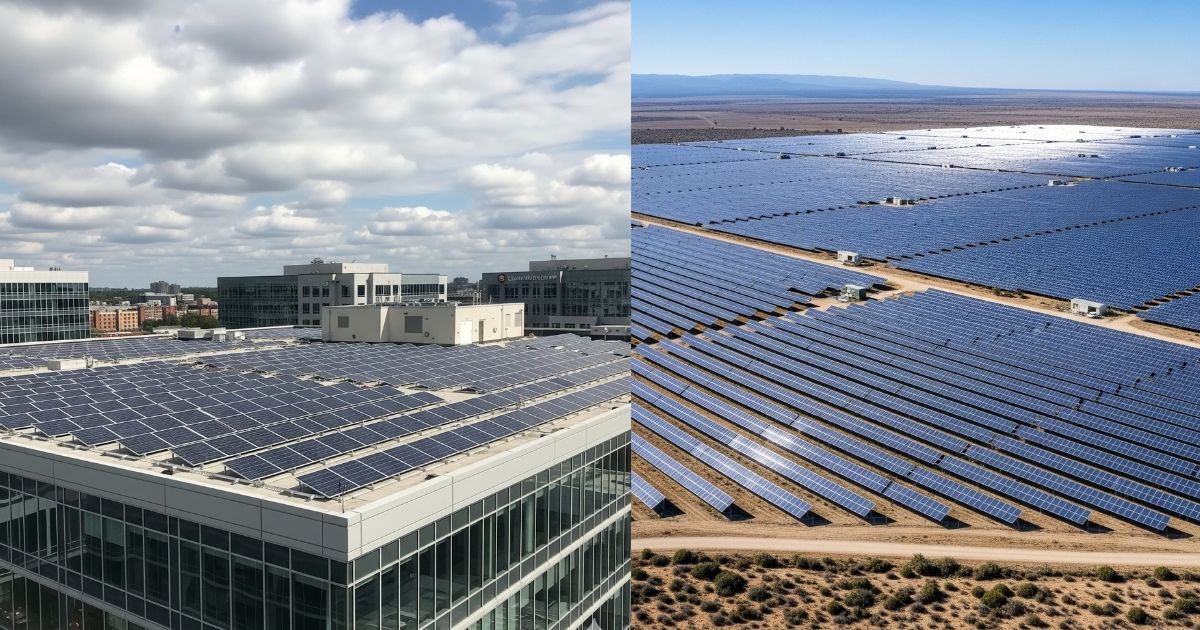
Most business owners understand that solar panels generate electricity from sunlight. What’s less clear is everything that happens between sunlight hitting the roof and the lights staying on — and why each part of that process matters when you’re making a significant capital investment.
Having designed and installed commercial solar systems across the UK for over a decade, from single-unit warehouses to multi-site retail chains, we’ve put this guide together to walk you through exactly how these systems work in a real business context.
Step 1: The Panels Capture Sunlight and Generate Electricity
Everything starts on the roof. Solar panels are made up of photovoltaic (PV) cells — typically silicon-based semiconductors — that react when exposed to light. When photons from sunlight hit these cells, they knock electrons loose and create a flow of electricity. That flow is direct current (DC).
In commercial installations, panels are grouped into large arrays and sized to match the business’s energy demand. A small office might have 30–40 panels; a distribution centre could have several hundred. When choosing the best commercial solar panels for your building, monocrystalline panels are generally the strongest performer — they produce more electricity per square metre and hold up well over time, which matters when you’re planning for a 25–40 year asset life.
Panel orientation and tilt angle have a real impact on output too. South-facing arrays at the right pitch generate noticeably more electricity over a year than a poorly oriented installation — something worth getting right at the design stage rather than discovering later.
Step 2: The Inverter Converts That Electricity Into Something Usable
The DC electricity your panels generate can’t power your building directly. Almost everything in a commercial premises — lighting, machinery, HVAC, refrigeration — runs on alternating current (AC). The inverter is what bridges that gap.
For most commercial installations, the choice of inverter depends on system size and site layout. Larger sites like warehouses typically use central or string inverters to handle high-voltage outputs efficiently. Smaller or more complex roofs — particularly those with shading from nearby structures — can benefit from microinverters, which optimise each panel individually rather than treating the whole array as one unit.
Good inverters also use maximum power point tracking (MPPT), which continuously adjusts to get the most electricity possible out of your panels at any given moment. It’s one of those technical details that adds up to meaningful difference in annual output.
Step 3: Battery Storage Keeps Energy Available When the Sun Isn’t
Solar panels only generate electricity when there’s light. For businesses that operate in the evening, run overnight processes, or simply want resilience against outages, battery storage fills that gap.
Lithium-ion batteries charge during the hours when your panels are producing more than your building is consuming, then release that stored energy when demand outpaces generation — typically late afternoon, evening, or during a cloudy spell. For a leisure centre running evening sessions, or a manufacturer running a second shift, this can make a significant difference to how much grid electricity you actually need to buy.
Battery storage also positions your business better for schemes like the Smart Export Guarantee (SEG), where you can choose when to export surplus energy to the grid rather than simply pushing it out whenever panels overproduce.
Step 4: Monitoring Software Keeps the System Performing as It Should
A commercial solar system isn’t something you install and forget. Output can drop gradually due to panel soiling, shading from new obstructions, or inverter degradation — and without monitoring, those losses are invisible until you notice your bills haven’t fallen as expected.
Real-time monitoring software tracks energy generation, consumption, and export continuously. It flags anomalies, identifies underperforming panels or strings, and produces the performance data you need to verify your system is delivering what it was designed to. This matters not just for day-to-day performance but for compliance with MCS standards and for maximising any applicable incentives.
Getting the best angle and orientation for your solar panels at installation is the starting point — monitoring is what ensures the system keeps performing to that standard over its lifetime.
Step 5: Grid Connection Turns Surplus Energy Into Revenue
The vast majority of UK commercial solar systems are grid-tied, meaning your building stays connected to the national grid alongside the solar installation. When your panels produce more than your business is using — on a sunny weekend when the building is quiet, for example — that surplus exports automatically to the grid.
Under the Smart Export Guarantee (SEG), your energy supplier pays you for every unit you export. Rates vary between suppliers and typically sit between 4p and 15p per kWh, providing a revenue stream that runs in parallel with your bill savings.
Grid-tied systems also mean your operations are never dependent on solar output alone. If generation drops — during winter months or extended cloud cover — the grid covers the shortfall seamlessly. For businesses in remote locations or those wanting full independence from the grid, off-grid and hybrid configurations are available, though they carry a higher upfront cost.
Getting grid integration right, particularly for systems above 50kW, requires a Distribution Network Operator (DNO) approval — a process that takes planning and paperwork but is essential for larger commercial systems. Done properly, it’s what allows strong return on investment across the full system lifetime.
Why the Installation Quality Behind All of This Matters
Understanding how a commercial solar system works also makes it easier to understand why the quality of the installation matters so much. These five stages — capture, conversion, storage, monitoring, and grid integration — are only as reliable as the components chosen and the workmanship behind them.
A poorly sized inverter, an incorrectly pitched array, inadequate monitoring, or a rushed DNO application all create problems that aren’t obvious at handover. They show up two or three years in, when output is quietly below expectation and the installer is no longer easy to reach.
The Commercial Solar Company works exclusively in the commercial sector. Every project is handled in-house — from site survey and system design through to installation, grid connection, and ongoing monitoring support. We don’t subcontract the technical work, and we don’t treat commercial projects as scaled-up domestic jobs. The engineering, the compliance, and the accountability stay with us throughout.
If you’re considering a commercial solar installation, speak to our team today for a free consultation — no obligation, just a straight conversation about what a system would look like for your site.
Frequently Asked Questions
How long does a commercial solar power system last?
Solar panels are typically warranted for 25 years and often remain productive for 30–40 years with proper maintenance. Inverters have a shorter lifespan — expect to replace them after 10–15 years. Batteries, if included, generally last 10–15 years depending on usage cycles and chemistry.
Do commercial solar panels work on cloudy days in the UK?
Yes. Panels generate electricity from daylight, not direct sunlight, so output continues on overcast days — typically at 10–25% of peak capacity depending on cloud cover. Modern panel technology has improved significantly in low-light performance, and battery storage smooths out the variability across the day.
What government incentives are available for commercial solar in the UK?
The main financial incentive in 2026 is the Smart Export Guarantee (SEG), which pays businesses for surplus electricity exported to the grid. Businesses can also claim capital allowances — including the Annual Investment Allowance (AIA) — on the installation cost, reducing taxable profit in the year of purchase. Always confirm eligibility with a tax adviser.
How much roof space does a commercial solar installation need?
As a rough guide, allow around 5–6 square metres per kW of installed capacity. A 50kW system therefore needs approximately 250–300m² of usable roof space. Shading, roof penetrations, and access requirements reduce the usable area, which is why a professional site survey is essential before any system is sized.
What maintenance does a commercial solar system require?
Routine maintenance is straightforward — annual inspections, periodic panel cleaning (typically once or twice a year depending on location and soiling levels), and inverter health checks. Budget £500–£1,500 per year for a typical commercial system. Monitoring software flags performance issues between visits, so problems are caught early rather than left to compound.
What’s the difference between a grid-tied and off-grid commercial solar system?
A grid-tied system stays connected to the national grid, drawing from it when solar generation is low and exporting surplus when it’s high. An off-grid system operates entirely independently, relying on battery storage to cover demand when panels aren’t generating. Most UK commercial installations are grid-tied — it’s simpler, cheaper, and more practical for businesses that need a guaranteed power supply.
