

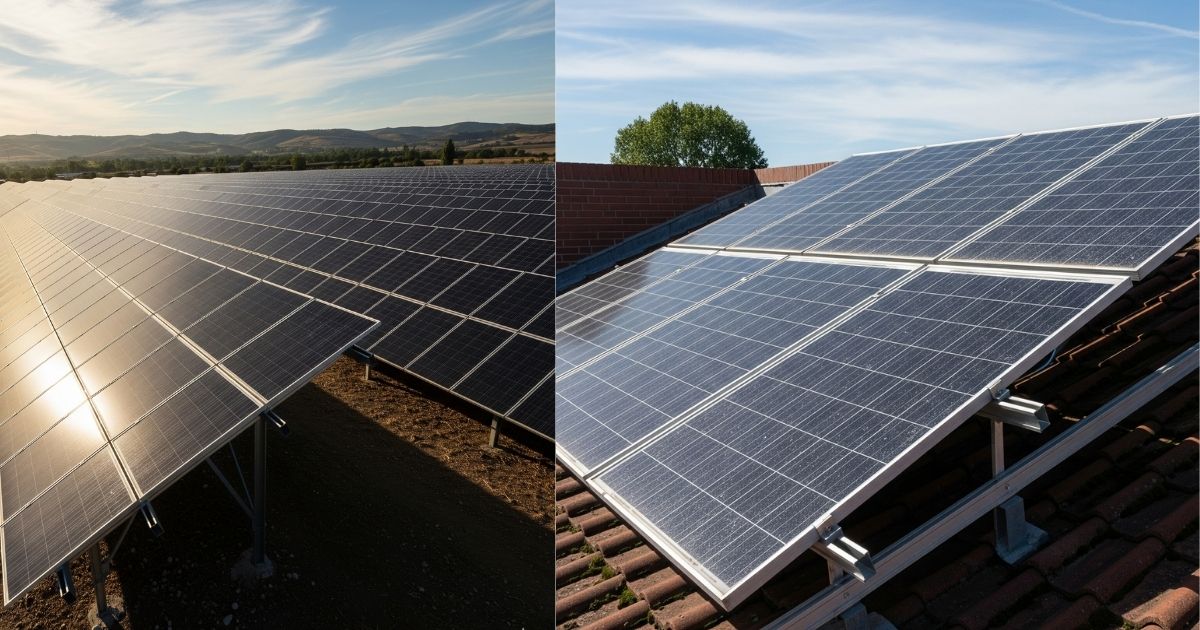
At The Commercial Solar Company, with over a decade of experience installing solar systems across the UK – from Manchester warehouses to London offices – we know that optimal solar panel orientation is key to maximising energy output and return on investment for businesses.
This guide breaks down the best commercial solar panel orientation to help UK business owners boost solar power efficiency through strategic placement of business solar panels. Whether you’re planning a new commercial photovoltaic system or optimising an existing one, understanding orientation principles can enhance your renewable energy generation.
The best orientation for commercial solar panels ensures maximum sunlight capture, directly impacting energy yield and cost savings. In the UK’s variable climate, precise orientation of industrial solar arrays is critical for performance. Below, we outline the steps to achieve optimal orientation, supported by data tables for clarity.
Determining Azimuth – Facing the Sun
The azimuth, or compass direction of solar panels, is the first factor in achieving the best commercial solar panel orientation. In the UK, south-facing panels (180° azimuth) capture the most sunlight daily, as the sun tracks across the southern sky in the Northern Hemisphere.
Deviations from true south reduce output, but slight adjustments can still be effective. The table below shows how azimuth impacts energy yield:
|
Azimuth (Direction) |
Energy Yield (% of Optimal) |
Notes |
|---|---|---|
|
180° (True South) |
100% |
Ideal for maximum sunlight capture |
|
135°/225° (SE/SW) |
85-95% |
Viable for constrained sites |
|
90°/270° (E/W) |
70-80% |
Significant output loss |
At The Commercial Solar Company, we use advanced surveying tools to align panels with true south, adjusting for magnetic declination (0-2° west in the UK in 2025), ensuring optimal energy production for enterprises.
Setting the Best Tilt Angle – Capturing Seasonal Sunlight
The tilt angle, measured from the horizontal, determines how effectively panels capture sunlight at different times of the year. In the UK, the optimal tilt for commercial solar panels is typically 30° to 40°, depending on latitude, to balance seasonal sunlight variations.
Using the best types of commercial solar panels at the right angle will massively benefit your business and the table below provides recommended tilt angles for key UK cities:
|
City |
Latitude |
Optimal Tilt Angle |
Notes |
|---|---|---|---|
|
London |
51.5°N |
35° |
Balances summer/winter sun |
|
Birmingham |
52.5°N |
36° |
Slightly steeper for northern latitude |
|
Edinburgh |
55.9°N |
38° |
Steeper tilt for lower winter sun |
Fixed-tilt systems are cost-effective for commercial solar installations, but adjustable mounts can increase output by up to 10% for businesses prioritising solar energy yield. Our team customises tilt angles based on your location to maximise efficiency.
Evaluating Site Conditions – Avoiding Shading
Site-specific factors like shading from buildings, trees, or other obstructions can significantly impact solar PV systems for businesses. A thorough site assessment ensures the best orientation for commercial solar panels by minimising shading and optimising placement.
For urban sites in cities like Glasgow or Birmingham, we may adjust azimuth or tilt slightly to avoid obstructions. Ground-mounted commercial solar arrays offer greater flexibility for ideal orientation. The table below outlines common shading challenges and solutions:
|
Shading Issue |
Impact on Output |
Solution |
|---|---|---|
|
Nearby Buildings |
10-30% loss |
Adjust azimuth or elevate panels |
|
Trees |
5-20% loss |
Trim trees or reposition panels |
|
Roof Structures |
5-15% loss |
Optimise panel layout |
Our site assessments ensure compliance with UK planning regulations while maximising sustainable energy savings for businesses.
Exploring Tracking Systems – Boosting Output
While fixed systems are standard, solar tracking systems can enhance commercial solar ROI by adjusting panel orientation dynamically. Single-axis trackers follow the sun’s east-west path, increasing output by 15-25%, while dual-axis trackers also adjust for seasonal tilt, boosting yield by up to 40%.
|
Tracker Type |
Output Increase |
Cost Consideration |
Best For |
|---|---|---|---|
|
Fixed System |
0% (Baseline) |
Lowest cost |
Most UK businesses |
|
Single-Axis Tracker |
15-25% |
Moderate cost |
Large, open sites |
|
Dual-Axis Tracker |
25-40% |
Highest cost |
High-yield projects |
For most UK businesses, fixed systems with optimal orientation offer the best value. We evaluate your site and budget to recommend the most efficient solar panel setup.
Monitoring Orientation Performance – Ensuring Longevity
Maintaining the best commercial solar panel orientation requires regular monitoring to detect issues like shading, dirt, or misalignment. Monitoring software tracks solar panel performance metrics, ensuring panels operate at peak efficiency for maximum business solar ROI.
Routine maintenance, including cleaning and inspections, preserves output and complies with Microgeneration Certification Scheme (MCS) standards. Our proprietary software provides real-time data, helping businesses maximise incentives like the Smart Export Guarantee (SEG) and extend system lifespans to 25+ years.
Frequently Asked Questions (FAQs)
Can solar panels work effectively if not perfectly south-facing?
Yes, southeast or southwest orientations can still perform well, with output reductions of 5-15%. We optimize placement based on your site.
How does roof pitch affect commercial solar panel orientation?
Roof pitch often sets the tilt angle. We use custom mounts to achieve the ideal angle, ensuring maximum energy capture on sloped roofs.
Are solar trackers worth the investment for UK commercial installations?
Trackers increase output but are costlier. Fixed systems with optimal orientation are typically more cost-effective for UK businesses.
How do seasonal changes impact solar panel orientation in the UK?
The sun’s path varies seasonally, but a 30-40° tilt balances year-round performance. Adjustable systems can optimize for specific seasons if needed.
What happens if shading occurs after installation?
We perform pre-installation shading analysis and use monitoring systems to detect post-installation issues, offering solutions like panel repositioning.
Why Choose The Commercial Solar Company?
Achieving the best commercial solar panel orientation unlocks significant energy savings and reduces emissions for UK businesses. At The Commercial Solar Company, as one of the best solar panel installers in the UK we deliver tailored solar energy solutions for UK businesses, from factories in Birmingham to retail chains in Edinburgh. Contact us for a free consultation to optimise your business solar installation and harness the full potential of renewable energy with our UK-wide expertise.
